The step-by-step sizing walkthrough
Step 1 — Measure the room, not the ceiling. Length × width in feet. A 12×14 bedroom is 168 sq ft. Round awkward rooms (L-shaped living areas, galley kitchens) to the largest rectangle a person actually stands in — you're cooling bodies, not corners.
Gotcha: Open-concept spaces aren't one room. If your kitchen flows into a dining area with no wall between them, size for each zone separately. One giant fan in the middle of 500 sq ft leaves both ends stagnant.
Step 2 — Convert square footage to blade span.
Finding the right how to choose ceiling fan size comes down to matching the features to how you will actually use it.
| Room size | Blade span | Typical rooms |
|---|---|---|
| Under 75 sq ft | 29–36" | Bathroom, walk-in closet, small hallway |
| 76–144 sq ft | 42–44" | Bedroom, home office, small kitchen |
| 145–225 sq ft | 50–54" | Living room, primary bedroom, dining room |
| 226–400 sq ft | 56–60" | Great room, open living area |
| Over 400 sq ft | Two fans | Long open-plan spaces |
Quick answer: Measure your room's square footage, then match it to blade span — under 75 sq ft wants a 29–36" fan, 76–144 sq ft wants 42–44", 145–225 sq ft wants 50–54", and anything bigger needs a 56"+ fan or two smaller ones. Then check your ceiling height, because a fan mounted too close to the ceiling moves far less air than the same fan hung 8–9 feet off the floor. Blade span and mounting height are the two numbers that matter; everything else is decoration.
Gotcha: Blade span is the full circle diameter, not one blade's length. A "52-inch fan" with 20-inch blades is measured tip-to-tip across the whole sweep.
Step 3 — Check ceiling height and pick a mount type. The bottom of the blades should sit 7–9 feet off the floor. That's the sweet spot where air actually reaches you.
- 8 ft ceilings flush mount or low-profile. No downrod.
- 9 ft ceilings 6" downrod.
- 10 ft ceilings 12" downrod.
- 12 ft+ 24"+ downrod.
Step 4 — Leave 18–24 inches of blade-tip-to-wall clearance. Draw the fan's circle on your floor plan. If a blade tip lands closer than 18" to a wall, sloped ceiling, or upper cabinet, drop one size.
Gotcha: This is the step that kills the "I'll just go bigger" instinct in kitchens and bedrooms with sloped ceilings.
Step 5 — Sanity-check the airflow number, not just the size. CFM (cubic feet per minute) is the honest measure. A well-designed 52" fan can move more air than a badly designed 56". If a listing states CFM, use it. If it doesn't, treat the size chart as your guide.
Gotcha: Motor type matters here. DC motors generally pull less power for the same airflow than older AC motors, which is why so many current fans advertise big efficiency savings.
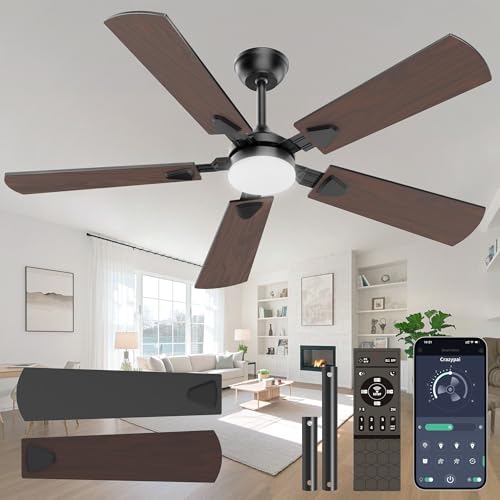
- 【52 In Ceiling Fan with Lights】This 52-inch modern ceiling fan features 5 20-inch blades, providing optimal airflow to keep your room cool and comfortable all year round. The
- 【Dimmable Modern Ceiling Fan】This 52” ceiling fan with dimmable lights features 3 color temperatures (3000K/4500K/6500K) to suit your preferences. It has a built-in memory
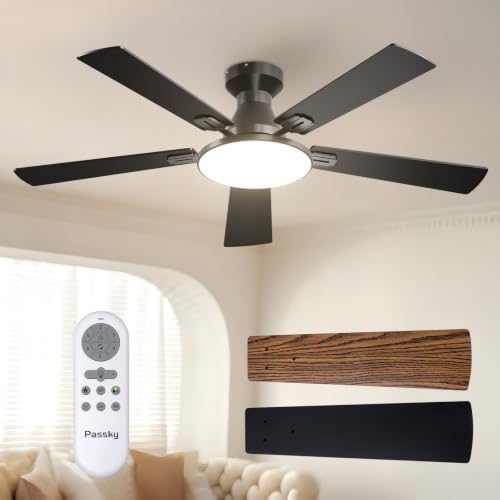
- Ceiling Fan with Light: Passky sleek ceiling fan with light, pass the breeze, light you sky. Our 52 inch modern classic ceiling fan with light remote control has A energy
- Ceiling Fan with Remote Control: Through the remote control, you can turn the fan on/off, adjust wind speeds, as well as realize the function of 1/2/4 hours timer off, at the same
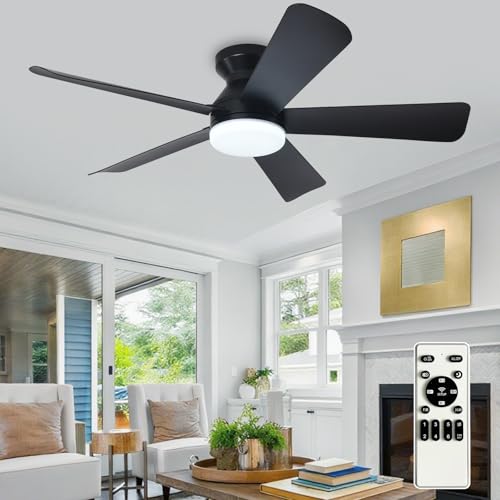
- 42-Inch Indoor Outdoor Ceiling Fan with Light: This Depuley Outdoor Ceiling Fan with Light is perfect for both indoor and outdoor spaces. Its 42-inch propeller design ensure wide
- Dimmable LED Light: Equipped with a quiet DC motor, this smart ceiling fan delivers powerful airflow while being energy-efficient. The black ceiling fan with light allows easy
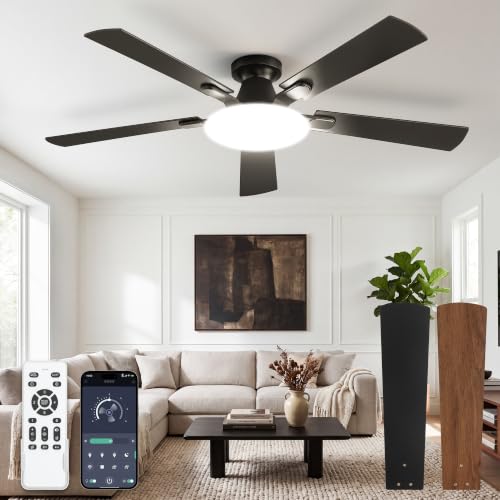
- ULTRA-BRIGHT 25W LED & 12" WIDE ILLUMINATION: Solve "too dim" complaint of standard fans. Our 52 inch ceiling fan features a 25W integrated LED panel—the largest in its
- SMART REMOTE & APP CONTROL & INTELLIGENT MEMORY: Enjoy dual-control convenience with our included remote and dedicated Bluetooth App. (Note: Uses a direct point-to-point Bluetooth
Sizing the awkward rooms people actually ask about
Kitchens. Cabinets, range hoods and pendant lights eat clearance. Most kitchens land in the 42–44" range even when the square footage says 52". Measure from the cabinet face, not the wall behind it, and keep blades out of the pendant zone over an island.
Caged / drum-style fans. The cage adds diameter but doesn't add sweep. Size by the blade span inside the cage, then add 2–4 inches of physical clearance for the housing itself. Caged fans also tend to sit lower — check the total fixture height before you commit on an 8-foot ceiling.
Chandelier fans. These hang lower by design, so the 7-foot floor clearance rule bites hardest. Over a dining table you can go lower — 6.5 feet above the table is fine, since nobody walks there. In a bedroom or hallway, don't.
Bunk-bed rooms and basements. Anything under 8 feet is flush-mount-only territory. Look for total fixture height in the listing; some low-profile fans state it explicitly.
What goes wrong
| Failure | What you'll notice | Fix |
|---|---|---|
| Fan too small for the room | Fan on high, still stuffy; only the spot directly beneath feels cool | Go up one size, or add a second fan in a long room |
| Fan too big / too close to walls | Whooshing pulse, papers fluttering, blade tips look uncomfortably close to a wall | Drop one size; keep 18–24" tip-to-wall |
| Mounted too tight to the ceiling | Weak breeze despite a large fan | Add a downrod if headroom allows — many fans ship with more than one length |
| Wobble | Rattle and visible shake at high speed | Check blade screws are even, confirm the box is fan-rated (not a standard light box), balance with the included kit |
| Cold in winter, blaming the fan | Room feels drafty in January | Flip the direction switch — updraft in winter pushes trapped warm air off the ceiling |
| Too dim as the only light | Dark corners, still need a lamp | Choose a fan with a wider light panel and higher lumen output |
Spec and compatibility table
| Product | Blade span | Mount | Motor | Speeds | Stated room size | Price |
|---|---|---|---|---|---|---|
| Crazypai Ceiling Fans with Lights, 52 Inch | 52" (5 × 20" blades) | 5" and 10" downrods included | DC, reversible, as low as 30 dB | 6 | 9'×9'+ suggested for the 10" downrod | Check price on Amazon |
| Passky Ceiling Fans with Lights, 52 inch | 52" | Flush mount | DC, reversible, as low as 35 dB | 6 | Not stated | Check price on Amazon |
| Depuley Modern Ceiling Fan with Light, 42-Inch | 42" (5 blades) | Flush mount | DC, reversible copper | 6 | 129–215 sq ft | Check price on Amazon |
| ZMISHIBO Low Profile 19.7'' | 19.7" (7 blades) | Low profile | DC copper, reversible | 6 | Not stated | Check price on Amazon |
| addlon Ceiling Fans with Lights, 42 Inch | 42" | Flush mount | DC, reversible, as low as 35 dB | 6 | Not stated | Check price on Amazon |
| LEDIARY 52 Inch Flush Mount | 52" | Flush mount, 10" total height | 35W DC, under 30 dB, 4042 CFM | 6 | Up to 225 sq ft | Check price on Amazon |
When the fix is a new one
Crazypai Ceiling Fans with Lights, 52 Inch Modern Ceiling Fans with Lights and Remote Control, DC Reversible Motor, Noiseless, 3CCT, Ceiling Fan for Bedroom, Living Room, Apartment Indoor/Outdoor Use — solves the mounting-height half of the problem
The one that ships with both a 5" and a 10" downrod, so you can set blade height after you see how the room feels rather than guessing at checkout. Crazypai suggests the 10" rod for spaces 9'×9' and up and the 5" for tighter rooms. 52" span, 5 blades at 20" each, six speeds, 3000K/4500K/6500K light, and a DC motor rated as low as 30 decibels.
Passky Ceiling Fans with Lights, 52 inch Flush Mount Ceiling fan with Remote Control, Low Profile Ceiling Fan for Bedroom, Farmhouse, Reversible, 3CCT, Dimmable, Noiseless DC Motor, Black — 52" sweep without the downrod height penalty
Full 52-inch span in a flush mount, which is the combination you want in a 145–225 sq ft room with an 8-foot ceiling. Passky notes it installs on a standard junction box with no extra drilling, which matters if you're renting. Six speeds, 1/2/4-hour timer, reverse control on the remote, fan and light switchable separately, rated down to 35 dB.
Depuley Modern Ceiling Fan with Light: 42-Inch Black Small Fans for Bedroom Indoor Outdoor - Dimmable Low Profile Ceiling Fans with Remote Control Flush Mount 5 Reversible Black Blades 6 Speeds Timer — the size chart, spelled out on the box
Depuley states this 42" fan is for rooms of 129–215 sq ft, which is the rare listing that does the sizing math for you. Good match for a standard bedroom, home office or a kitchen where cabinet clearance rules out 52". Six speeds, 3000K/4500K/6000K, stepless 10–100% dimming, night-light mode and a 2–4 hour timer.
ZMISHIBO Low Profile 19.7'' Ceiling Fans with Lights and Remote, Black — for the rooms too small for a real fan
At 19.7 inches this is the answer for a laundry room, walk-in closet, small bath or entry — spaces where a 42" fan would put blade tips into the walls. Seven blades, six speeds, DC copper motor, 2200 lumens at 3000K–6000K with 10–100% dimming, and both remote and Bluetooth app control.
addlon Ceiling Fans with Lights, 42 Inch Low Profile Ceiling Fan with Light and Remote Control, Flush Mount, Reversible, 3CCT, Dimmable, Quiet, Black Small Ceiling Fan for Bedroom Indoor/Outdoor Use — 42" flush mount with memory for wall-switch rooms
If your fan is wired to a wall switch, addlon's memory function restores the previous state when power comes back, so you're not resetting speed every time. 42" span, flush mount, six speeds, 1/2/4-hour timer, reverse from the remote, rated down to 35 dB, with double-sided black and dark wood blades.
LEDIARY 52 Inch Flush Mount Ceiling Fans with Lights, Remote & APP Control — the one with published CFM and a real room rating
LEDIARY states 4042 CFM from a 35W DC motor, under 30 dB, compatible with rooms up to 225 sq ft — actual numbers to check your sizing against instead of a vague "large room" claim. Total fixture height is 10 inches, so it clears heads on low ceilings, and the 30W / 3000LM LED panel with 12-inch disk is aimed at rooms where the fan is the only light source. Damp-rated for covered porches.
FAQ
Is a bigger fan always better? No. Oversizing forces you to run a big fan on low to avoid a pulsing draft, and blade tips too near a wall create turbulence instead of flow. Match the span to the room and you'll get more usable airflow.
Can I use two small fans instead of one big one? In a long or L-shaped room, yes — two 42" fans usually beat one 52" for even coverage. Space them so their circles don't overlap and keep both 18"+ from walls.
Does blade count change how much air moves? Less than people think. Motor design, blade pitch and span drive airflow. More blades often means quieter running rather than stronger wind — which is why 5- and 7-blade fans are common in bedrooms.
How do I size a fan for a sloped ceiling? Measure the ceiling height at the mounting point, not the low side, then confirm the blades clear the slope through their full sweep. Sloped ceilings frequently mean dropping one blade size to keep tip clearance.
Related guides
- Best home cooling, heating and fans - ceiling fans, tower fans, space heaters, misting fans, portable air conditioners, window air conditioners with Self-Employment
- Expert Advice on Best home cooling, heating and fans - ceiling fans, tower fans, space heaters, misting fans, portable air conditioners, window air conditioners
- Best home cooling, heating and fans - ceiling fans, tower fans, space heaters, misting fans, portable air conditioners, window air conditioners After Recent Issues
Key Takeaways
- Choosing the right how to choose ceiling fan size means matching the key features to your specific needs and budget
- Read real customer reviews and check the return policy before you commit
- Compare value across models — the priciest option is not always the best fit