As an Amazon Associate this site earns from qualifying purchases.
Sizing a ceiling fan, step by step
Step 1 — Measure the room, not the ceiling. Length × width in feet. For an L-shaped or open-plan room, treat each seating zone as its own room. A single 52" fan in a 25-foot great room does not cool the far corner — two smaller fans beat one big one every time.
Gotcha: People measure the whole open floor plan, buy one enormous fan, and wonder why half the space is still stuffy. Air throw drops off fast past about 8 feet from the blade tips.
Step 2 — Convert square footage to blade span.
Finding the right how to choose right size ceiling fan comes down to matching the features to how you will actually use it.
| Room size | Blade span | Typical rooms |
|---|---|---|
| Under 75 sq ft | 29–36" | Bathroom, laundry, small office |
| 76–144 sq ft | 42–44" | Bedroom, kids' room, small patio |
| 145–225 sq ft | 44–52" | Standard bedroom, dining room |
| 226–400 sq ft | 52–56" | Living room, primary bedroom |
| 400+ sq ft | Two fans, or 60"+ | Great room, open plan |
Quick answer: Match the fan's blade span to your room's square footage — roughly 29–36" for rooms under 75 sq ft, 42–44" for 76–175 sq ft, and 52" for 176–350 sq ft. Then check ceiling height: you need at least 7 feet of clearance under the blades, and 8–10 inches of downrod for every foot of ceiling above 8 feet. Blade span is the easy part; the mistakes almost always happen at ceiling height and mounting type.
The 42-vs-52 question comes up constantly. If your room is 12×12 (144 sq ft), a 42" fan is correct. At 14×14 (196 sq ft), 52" is correct. In the overlap zone around 150–180 sq ft, either works — go 52" if the ceiling is 9 feet or higher, 42–44" if it's a standard 8-foot ceiling where you'd rather not feel a hurricane over the bed.
Step 3 — Check ceiling height and pick a mount. This is where sizing guides usually stop and where installs actually fail.
- Under 8 feet: flush mount / low-profile only. No downrod.
- 8 feet exactly: flush mount, or a very short (3–5") downrod.
- 9 feet: 6–12" downrod.
- 10 feet: 12–24" downrod.
- Sloped ceiling: you need a canopy rated for your slope angle, plus a longer downrod so the blades clear the high side.
Gotcha: Blades also need roughly 18 inches of clearance from the nearest wall, and 24" is better. Measure from where the blade tip will sit, not from the motor housing.
Step 4 — Check the CFM, not just the diameter. Two 52" fans can move wildly different amounts of air. CFM (cubic feet per minute) is the number that tells you whether a fan actually cools. For reference, the ZMISHIBO 52 Inch Ceiling Fans with Lights, Remote&App Control, Flush Mount lists an average 3,057 CFM, which is a solid figure for a 52" fan. If a listing doesn't state CFM at all, that's a signal in itself.
Step 5 — Confirm the mounting box. A ceiling fan needs a fan-rated electrical box, not a standard lighting box. Fan-rated boxes are stamped and secured to a joist or brace bar. A light box will hold a light fixture fine and will eventually drop a fan. Look up before you buy.
Step 6 — Decide indoor vs. damp vs. wet rated. Patios and covered porches need a damp-rated fan at minimum. If the fan can catch blowing rain, you need wet-rated. Manufacturers are specific about this for a reason — the Passky Ceiling Fans with Lights, 52 inch Flush Mount Ceiling fan with Remote Control states it suits patios, breezeways, gazebos and pergolas but must not be exposed directly to rain. Read that line on any fan you're considering for outdoors, and check the Q&A and reviews on the listing yourself before committing.
Step 7 — For caged fans, size down. Caged and drum-style fans have a smaller effective blade span than their outer housing suggests, and the cage disrupts airflow. Treat a caged fan as one size class smaller than its stated diameter when matching it to a room.
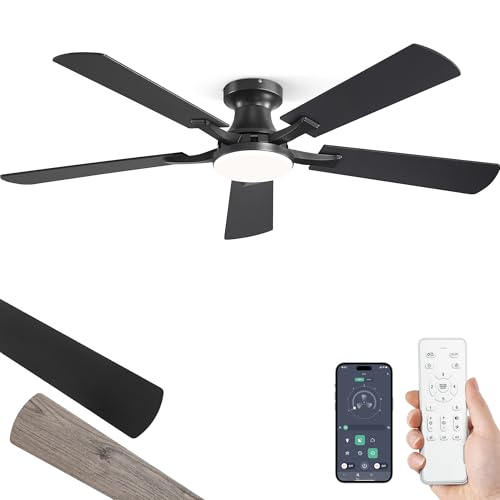
- Perfect Size for Rooms: This 52-inch ceiling fan is ideal for cooling and illuminating spacious areas like living rooms, bedrooms, and kitchen, featuring an 20W 2000LM bright
- High Configuration: The flush mount fan is equipped with APP & Remote Control, 10~100% Dimmable, Stepless Color Temperature (warm neutral cool white, 3000K6500K), Memory
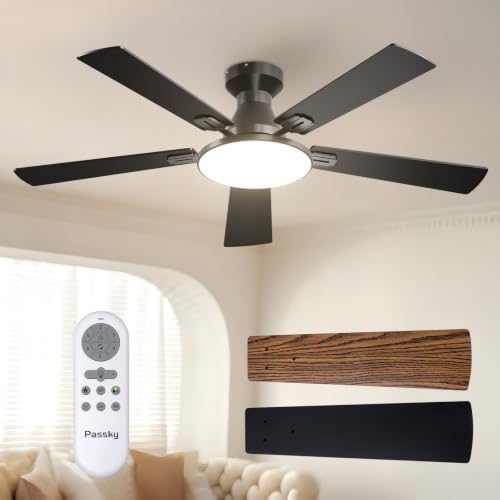
- Ceiling Fan with Light: Passky sleek ceiling fan with light, pass the breeze, light you sky. Our 52 inch modern classic ceiling fan with light remote control has A energy
- Ceiling Fan with Remote Control: Through the remote control, you can turn the fan on/off, adjust wind speeds, as well as realize the function of 1/2/4 hours timer off, at the same
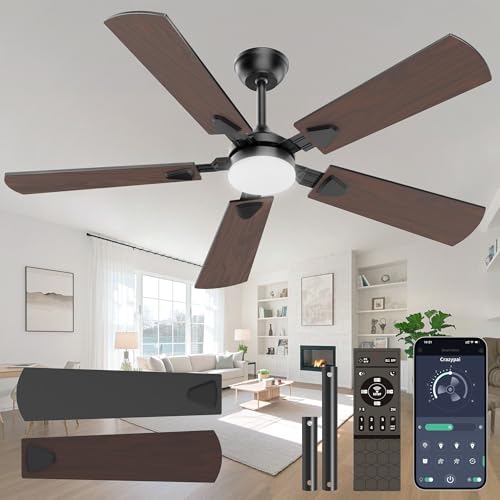
- 【52 In Ceiling Fan with Lights】This 52-inch modern ceiling fan features 5 20-inch blades, providing optimal airflow to keep your room cool and comfortable all year round. The
- 【Dimmable Modern Ceiling Fan】This 52” ceiling fan with dimmable lights features 3 color temperatures (3000K/4500K/6500K) to suit your preferences. It has a built-in memory
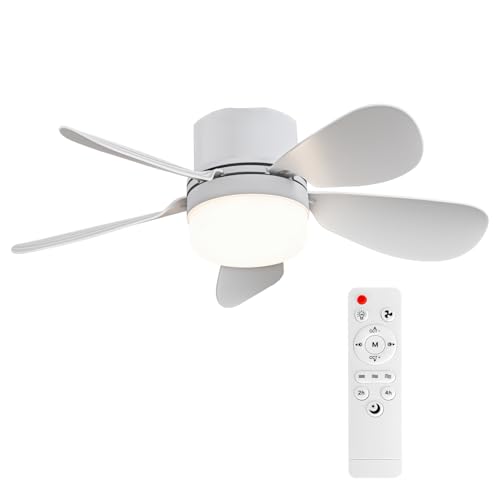
- Fan light size: diameter 16.54 inches, height 6.29 inches, weight 1 pound. Fan power: 12 watts, light power: 10 watts.Voltage: 85V -265V,Main functions: dimming function, timing
- Easy installation: The installation method of this socket ceiling fan is as simple as that of a regular light bulb, and it is completely wireless, without causing any clutter. The
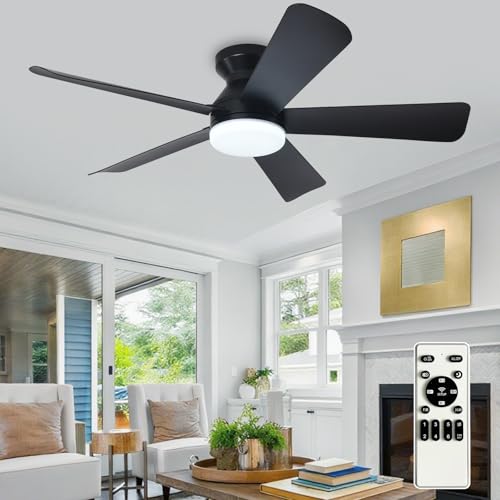
- 42-Inch Indoor Outdoor Ceiling Fan with Light: This Depuley Outdoor Ceiling Fan with Light is perfect for both indoor and outdoor spaces. Its 42-inch propeller design ensure wide
- Dimmable LED Light: Equipped with a quiet DC motor, this smart ceiling fan delivers powerful airflow while being energy-efficient. The black ceiling fan with light allows easy
What goes wrong, and how to fix it
The fan wobbles. Symptom: visible shake at high speed, sometimes a ticking sound. Cause: unbalanced blades, loose blade screws, or a non-fan-rated box flexing. Fix: tighten every blade screw, then use the balance kit that shipped in the box. If it still wobbles, check the box.
The room's still hot. Symptom: fan runs, you feel nothing at the couch. Cause: fan is undersized, mounted too high, or spinning the wrong direction. Fix: confirm it's blowing down (counterclockwise) in summer. Ceiling fans cool people, not rooms — if you can't feel the air, the fan is too small or too far away.
Blades nearly touch a light fixture or sloped ceiling. Symptom: you notice during install, or worse, after. Fix: longer downrod, or step down one blade size. Don't try to "just angle it."
It's noisy at night. Symptom: hum or click at low speed. Cause: AC motors hum more than DC motors, and cheap bearings click. Fix: DC-motor fans run notably quieter — the Crazypai lists operation as low as 30 dB, Passky as low as 35 dB. If your existing fan hums, that's usually a motor you can't fix.
Ceiling is 7'6" and nothing fits. Symptom: every fan you like needs a downrod. Fix: low-profile / flush-mount fans exist specifically for this. Don't compromise the 7-foot clearance.
Spec comparison
| Product | Blade span | Mount | Motor | Noise | Light | Price |
|---|---|---|---|---|---|---|
| Crazypai 52 Inch Modern Ceiling Fans | 52" (5 × 20" blades) | 5" or 10" downrod | DC, reversible | As low as 30 dB | 3CCT 3000/4500/6500K, dimmable | Check price on Amazon |
| Passky 52 inch Flush Mount | 52" | Flush mount | DC, reversible | As low as 35 dB | 3CCT, dimmable | Check price on Amazon |
| ASALL Socket Fan Light | 16.54" diameter | Screws into E26/E27 socket | Not stated | Not stated | 10W, 1000 lumens, dimmable | Check price on Amazon |
| ZMISHIBO Low Profile 19.7'' | 19.7", 7 blades | Flush mount | DC, reversible | Not stated | 2200 lm, 3000K–6000K | Check price on Amazon |
| ZMISHIBO 52 Inch Flush Mount | 52" | Flush mount | DC | Not stated | 20W, 2000 lm, 3000K–6500K | Check price on Amazon |
| Depuley 42-Inch Low Profile | 42", 5 blades | Flush mount | DC, reversible | Not stated | 3CCT 3000/4500/6000K, dimmable | Check price on Amazon |
When the fix is a new fan
Crazypai Ceiling Fans with Lights, 52 Inch Modern Ceiling Fans with Lights and Remote Control, DC Reversible Motor, Noiseless, 3CCT, Ceiling Fan for Bedroom, Living Room, Apartment Indoor/Outdoor Use — solves the ceiling-height guess
Passky Ceiling Fans with Lights, 52 inch Flush Mount Ceiling fan with Remote Control, Low Profile Ceiling Fan for Bedroom, Farmhouse, Reversible, 3CCT, Dimmable, Noiseless DC Motor, Black — 52" span on a low ceiling
Depuley Modern Ceiling Fan with Light: 42-Inch Black Small Fans for Bedroom Indoor Outdoor — the 42" answer for 129–215 sq ft
ZMISHIBO Low Profile 19.7'' Ceiling Fans with Lights and Remote, Black — for rooms too small for a real fan
A 19.7" span for laundry rooms, walk-in closets and small offices where a 42" fan would be absurd. Seven blades, six speeds, reversible DC motor. ZMISHIBO Low Profile 19.7'' Ceiling Fans with Lights and Remote, BlackZMISHIBO 52 Inch Ceiling Fans with Lights, Remote&App Control, Flush Mount — when you want the CFM number stated
ASALL Socket Fan Light with Remote Control — no wiring, no junction box
FAQ
42" or 52" — how do I break the tie? Under 145 sq ft, go 42". Over 200 sq ft, go 52". In between, let ceiling height decide: 9 feet or higher favors 52", a standard 8-foot ceiling favors 42–44".
44" vs 52" for a 15×12 bedroom? That's 180 sq ft, so 52" is the better airflow match. Choose 44" only if furniture or a sloped ceiling puts a blade tip within 18 inches of a wall.
How do I size a fan for a patio? Same square-footage math, but measure the covered area only — open sides let air escape, so bias one size up. Then confirm the fan is damp- or wet-rated for your exposure.
Does a bigger fan always cool better? No. An oversized fan on a low ceiling creates a chopping, uncomfortable draft, and CFM matters more than diameter. A well-specified 42" fan can outperform a weak 52".
Related guides
- Best home cooling, heating and fans - ceiling fans, tower fans, space heaters, misting fans, portable air conditioners, window air conditioners with Past Challenges
- Midea U-Shaped Window AC Review: Is It Worth It?
- Best home cooling, heating and fans - ceiling fans, tower fans, space heaters, misting fans, portable air conditioners, window air conditioners for First-Time Buyers
Key Takeaways
- Choosing the right how to choose right size ceiling fan means matching the key features to your specific needs and budget
- Read real customer reviews and check the return policy before you commit
- Compare value across models — the priciest option is not always the best fit