As an Amazon Associate this site earns from qualifying purchases.
Specification comparison
Quick answer: Match blade span to room size first (42" for rooms up to ~215 sq ft, 52" for larger living spaces), then pick a flush-mount/low-profile model if your ceiling is under 8 feet. After that, the specs that actually change your daily experience are CFM airflow, motor noise in decibels, and whether the light is dimmable with adjustable color temperature.
Everything else — app control, blade finish, number of speeds — is preference, not performance. Below is a look at six low-profile fans in the $40–60 range, what their published specs actually tell you, and where each one makes sense.
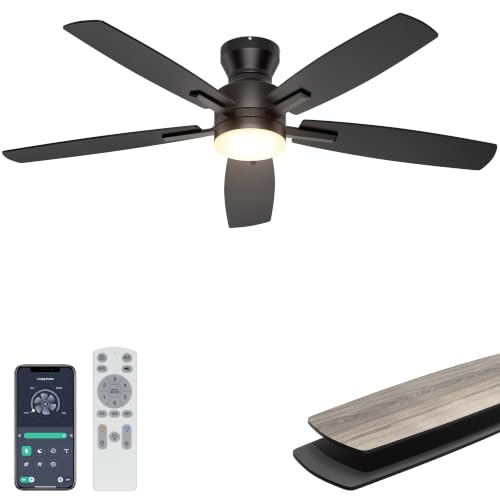
- Smart Ceiling Fans with APP & Remote Control: This modern ceiling fan with lights has all functions controllable via both the included remote and smartphone app. Adjust fan speed
- Dimmable & Energy-Efficient LED Lighting:Equipped with an 18W LED light source (3000K warm/4500K natural/6000K cool white), this flush mount ceiling fan offers eye-friendly
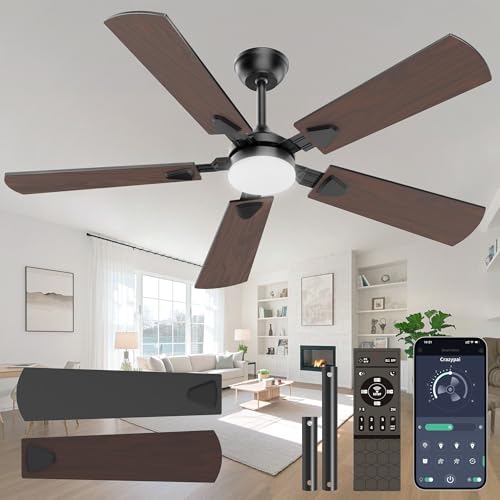
- 【52 In Ceiling Fan with Lights】This 52-inch modern ceiling fan features 5 20-inch blades, providing optimal airflow to keep your room cool and comfortable all year round. The
- 【Dimmable Modern Ceiling Fan】This 52” ceiling fan with dimmable lights features 3 color temperatures (3000K/4500K/6500K) to suit your preferences. It has a built-in memory
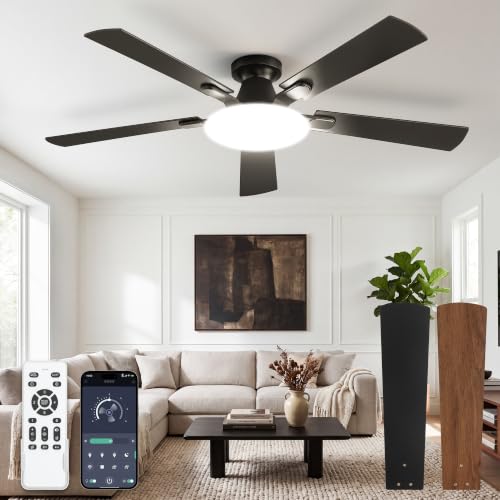
- ULTRA-BRIGHT 25W LED & 12" WIDE ILLUMINATION: Solve "too dim" complaint of standard fans. Our 52 inch ceiling fan features a 25W integrated LED panel—the largest in its
- SMART REMOTE & APP CONTROL & INTELLIGENT MEMORY: Enjoy dual-control convenience with our included remote and dedicated Bluetooth App. (Note: Uses a direct point-to-point Bluetooth
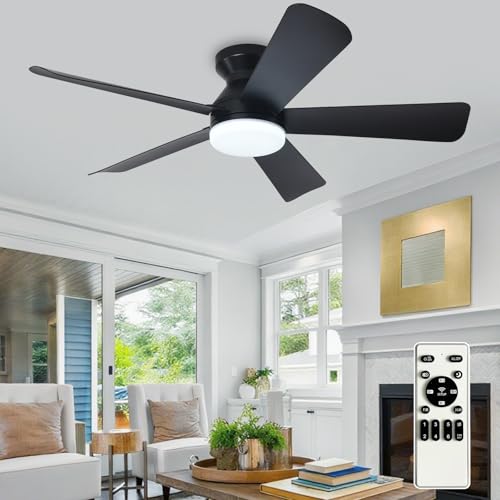
- 42-Inch Indoor Outdoor Ceiling Fan with Light: This Depuley Outdoor Ceiling Fan with Light is perfect for both indoor and outdoor spaces. Its 42-inch propeller design ensure wide
- Dimmable LED Light: Equipped with a quiet DC motor, this smart ceiling fan delivers powerful airflow while being energy-efficient. The black ceiling fan with light allows easy
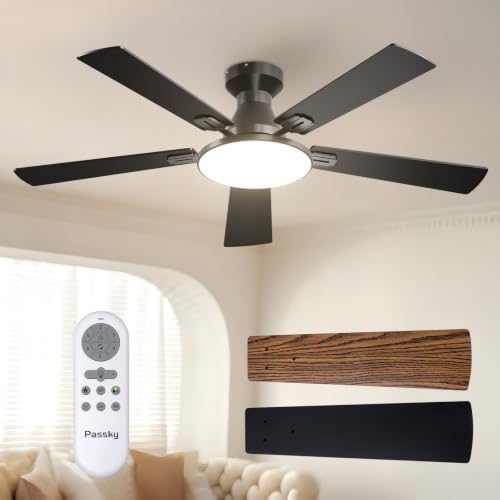
- Ceiling Fan with Light: Passky sleek ceiling fan with light, pass the breeze, light you sky. Our 52 inch modern classic ceiling fan with light remote control has A energy
- Ceiling Fan with Remote Control: Through the remote control, you can turn the fan on/off, adjust wind speeds, as well as realize the function of 1/2/4 hours timer off, at the same
How to actually size the fan
Blade span is the diameter, tip to tip. The rule most people get wrong: bigger isn't automatically better. A 52" fan in a 10×10 bedroom moves air but also throws it at the walls and back at you in a way that feels gusty rather than pleasant.
Finding the right how to choose ceiling fan buyers guide comes down to matching the features to how you will actually use it.
Depuley states a room-size range of 129–215 sq ft for its 42" model — that's a useful anchor. Under about 150 sq ft, a 42" fan is the sensible pick. Between 150 and 250, either span works. Above that, go 52". LEDIARY lists compatibility with rooms up to 225 sq ft for its 52" fan, which is a more conservative claim than you'd expect — worth reading the listing yourself if your room is bigger than that.
Ceiling height matters more than most people realize. You want blades roughly 7–9 feet off the floor. If your ceiling is 8 feet or lower, a flush-mount (low-profile) fan is not optional — it's the only safe choice. Every fan here is flush-mount or low-profile. LEDIARY specifies a 10-inch total height, which is the only hard number given, and it explicitly mentions bunk-bed rooms. Crazypai is the outlier: it ships with 5" and 10" downrods instead of mounting flush, so it needs more headroom than the rest.
The specs that actually matter
CFM (cubic feet per minute) is the honest measure of airflow. Only two fans here publish it: Ohniyou at 4,580 and LEDIARY at 4,042. When a listing skips CFM, you're buying on faith. That's not disqualifying at $45, but it's worth knowing.
Decibels. Ohniyou claims as low as 20 dB, LEDIARY under 30 dB, Crazypai as low as 30 dB, addlon and Passky as low as 35 dB. These are lowest-speed figures — every fan is louder at speed 6. If you sleep in the room, the gap between 20 dB and 35 dB is real.
DC vs. AC motors. All six use DC motors. That's why they all offer 6 speeds and reversibility, and why several claim 80% energy savings versus traditional fans. DC is the right call at this price point and you shouldn't settle for less.
Reversibility means downdraft in summer, updraft in winter to push warm air off the ceiling. Every fan here has it. Use it.
Light quality. If the fan is your room's only light source, look at wattage and lumens, not just "dimmable." LEDIARY publishes 30W and 3000 lumens across a 12-inch panel; Ohniyou publishes 18W. Everything else states color temperature and dimming but not brightness. For a dining room or master bedroom where the fan replaces a ceiling light, that difference is significant.
Who this class of fan is for
- Renters and anyone replacing an existing fixture. Passky specifically notes it works with a standard junction box without extra drilling.
- Low-ceiling rooms — bedrooms, apartments, finished basements, bunk-bed rooms.
- People who want light and airflow from one fixture without a $200+ budget.
- Covered patios and porches. Several of these are rated for covered outdoor use; LEDIARY states a damp rating explicitly. None should be exposed directly to rain.
Who should skip it
- Sloped or vaulted ceilings. Flush-mount fans generally need a flat ceiling. Ohniyou states flat-ceiling installation directly.
- Rooms over ~250 sq ft, or great rooms. You'd want a larger span or two fans.
- Uncovered outdoor spaces. addlon and Passky both warn against direct rain exposure.
- Anyone wanting Wi-Fi and voice assistants. LEDIARY's app is point-to-point Bluetooth — no router, no hub, which also means no Alexa routines and no control from outside the house.
- Anyone who wants replaceable bulbs. These are integrated LED panels. When the LED goes, the fixture goes.
Honest trade-offs
At $43–60 you're getting DC motors and 3CCT dimmable lights that cost twice as much five years ago. The compromises are real, though.
Published specs are thin. Four of six fans don't state CFM. Two don't state a room-size range. Marketing decibel figures are best-case, not typical. Nobody here publishes a warranty term in the feature list.
"Scratch-resistant" and specific finish durability aren't stated by any of these manufacturers, so treat any such claim skeptically. What is stated is that all six use dual-sided blades — black one side, wood-grain or natural on the other (Passky's is white/yellow wood). That flexibility is genuinely useful if you're unsure what matches your room, and it's a feature you won't find on premium single-finish fans.
Installation claims run optimistic. Ohniyou says 30 minutes. That assumes existing wiring, a working junction box, and a second person. Budget more.
What to check on the listing before you buy
Listings change without notice, so verify these yourself at the moment you order:
- Current price. The figures here are a snapshot.
- Variant. Blade span (42" vs 52"), finish, and light configuration are often separate options under the same listing — the price shown may not be for the size you selected.
- Warranty and returns. None of these list a warranty term in the product features. Check the seller's stated warranty and the return window before committing.
- Damp/wet rating if it's going outdoors. Confirm on the listing itself, not on a spec summary.
- Owner reviews and Q&A. Go read them. Sort by most recent and filter for mentions of wobble, light flicker, and remote pairing — those are the failure modes worth checking for on any budget fan.
Consider these instead
LEDIARY 52 Inch Flush Mount Ceiling Fans with Lights, Remote & APP Control — consider instead if…
…the fan is your room's main light. The LEDIARY 52 Inch Flush Mount Ceiling Fans with Lights, Remote & APP Control publishes a 30W / 3000-lumen panel across a 12-inch disk with 120°+ coverage, plus 12–100% stepless dimming, 4,042 CFM, under 30 dB, and a 10-inch total height. It's the most fully specified fan here.
Ohniyou 52'' Low Profile Ceiling Fan with Lights, Remote/APP Control, Black — consider instead if…
…airflow and quiet are your priorities. The Ohniyou 52'' Low Profile Ceiling Fan with Lights, Remote/APP Control, Black states the highest airflow in this group at 4,580 CFM and the lowest noise floor at 20 dB, with app and remote control. Note the 18W light is dimmer on paper than LEDIARY's.
addlon Ceiling Fans with Lights, 42 Inch Low Profile Ceiling Fan with Light and Remote Control, Flush Mount, Reversible, 3CCT, Dimmable, Quiet, Black Small Ceiling Fan for Bedroom Indoor/Outdoor Use — consider instead if…
…your room is small. The addlon Ceiling Fans with Lights, 42 Inch Low Profile Ceiling Fan with Light and Remote Control, Flush Mount, Reversible, 3CCT, Dimmable, Quiet, Black Small Ceiling Fan for Bedroom Indoor/Outdoor Use is a 42" flush mount with an A energy rating, 6 speeds, 1/2/4-hour timer, and a memory function that restores your last settings after a wall-switch cutoff.
Depuley Modern Ceiling Fan with Light: 42-Inch Black Small Fans for Bedroom Indoor Outdoor - Dimmable Low Profile Ceiling Fans with Remote Control Flush Mount 5 Reversible Black Blades 6 Speeds Timer — consider instead if…
…you want a stated room-size range. The Depuley Modern Ceiling Fan with Light: 42-Inch Black Small Fans for Bedroom Indoor Outdoor - Dimmable Low Profile Ceiling Fans with Remote Control Flush Mount 5 Reversible Black Blades 6 Speeds Timer specifies 129–215 sq ft, and adds a one-touch night-light mode plus 10–100% stepless dimming.
Passky Ceiling Fans with Lights, 52 inch Flush Mount Ceiling fan with Remote Control, Low Profile Ceiling Fan for Bedroom, Farmhouse, Reversible, 3CCT, Dimmable, Noiseless DC Motor, Black — consider instead if…
…you're renting or want a lighter finish. The Passky Ceiling Fans with Lights, 52 inch Flush Mount Ceiling fan with Remote Control, Low Profile Ceiling Fan for Bedroom, Farmhouse, Reversible, 3CCT, Dimmable, Noiseless DC Motor, Black mounts to a standard junction box with no extra drilling, its remote doubles as a wall switch, and the blades are white on one side and yellow wood grain on the other.
Crazypai Ceiling Fans with Lights, 52 Inch Modern Ceiling Fans with Lights and Remote Control, DC Reversible Motor, Noiseless, 3CCT, Ceiling Fan for Bedroom, Living Room, Apartment Indoor/Outdoor Use — consider instead if…
…you have ceiling height to spare and want the lowest price. The Crazypai Ceiling Fans with Lights, 52 Inch Modern Ceiling Fans with Lights and Remote Control, DC Reversible Motor, Noiseless, 3CCT, Ceiling Fan for Bedroom, Living Room, Apartment Indoor/Outdoor Use ships with 5" and 10" downrods rather than mounting flush, uses a pure-copper DC motor rated as low as 30 dB, and includes a 10-second memory function for light settings.
FAQ
What's a good ceiling fan rating to look for? Two ratings matter. Energy efficiency — addlon and Passky both state an A rating — and location rating. A damp rating, like LEDIARY's, means covered outdoor use is fine; nothing here is wet-rated for direct rain.
How do I choose the right size fan for my room? Measure square footage. Under roughly 150 sq ft, a 42" fan; 150–250, either; above that, 52" or larger. Then check ceiling height — under 8 feet means flush mount, no exceptions.
Do I need app control, or is a remote enough? A remote is enough for most people. Ohniyou and LEDIARY both add app control, but LEDIARY's is Bluetooth point-to-point, so it works from the same room, not from work. Prioritize CFM and decibels over connectivity.
What should I look for in a fan with lights specifically? Adjustable color temperature (all six offer 3CCT), a wide dimming range, and — if it's the room's only light — published wattage or lumens. Also check whether the fan and light can be controlled separately; Passky and Depuley both state they can.
Related guides
- The Best Portable Air Conditioners for 2026
- LG Dual Inverter Portable AC Review: What to Know
- About Gustelle: Our Editorial Team and Research Standards
Key Takeaways
- Choosing the right how to choose ceiling fan buyers guide means matching the key features to your specific needs and budget
- Read real customer reviews and check the return policy before you commit
- Compare value across models — the priciest option is not always the best fit