As an Amazon Associate this site earns from qualifying purchases.
Specifications at a glance
| Product | Price | Type | Airflow | Water capacity | Power draw | Remote |
|---|---|---|---|---|---|---|
| ALORAIR Built-in Cooling & Heating Room to Room Air Transfer Fan, 300 CFM | Check price on Amazon | Wall-mounted transfer fan with active cool/heat | 300 CFM | N/A | Not stated | Infrared remote |
| Newair Evaporative Air Cooler | Check price on Amazon | Portable evaporative cooler | 470 CFM | 1.76 gal removable | 110 watts | Remote + 7.5-hr timer |
| MELOPHY 3-in-1 Evaporative Air Cooler | Check price on Amazon | Portable evaporative tower | Not stated (19" outlet) | 1 gal pull-out | Not stated | Remote + 24-hr timer |
| KOTEK Evaporative Air Cooler | Check price on Amazon | Portable evaporative cooler | Not stated | 4L | Not stated | Not stated (touch buttons) |
| Arctic Air Pure Chill Deluxe | Check price on Amazon | Personal evaporative cooler | Not stated | Not stated (top-fill) | 8–10 watts | Not stated (touch controls) |
| Jiawu Mini Evaporative Air Cooler | Check price on Amazon | Personal misting fan | Not stated | 500 mL | Not stated | Not stated |
Quick answer: If you have no central AC, your realistic options are moving air between rooms, evaporative (swamp) cooling, or a personal misting fan at your desk — none of them are refrigerant air conditioners, and none will drop a humid room by 15°F. Evaporative coolers work best in dry heat and add moisture to the air; in a muggy climate they mostly move air and make things damper. The one unit here that actively cools rather than just circulating is the ALORAIR Built-in Cooling & Heating Room to Room Air Transfer Fan, 300 CFM, which uses a thermostat to trigger a built-in cooling system.
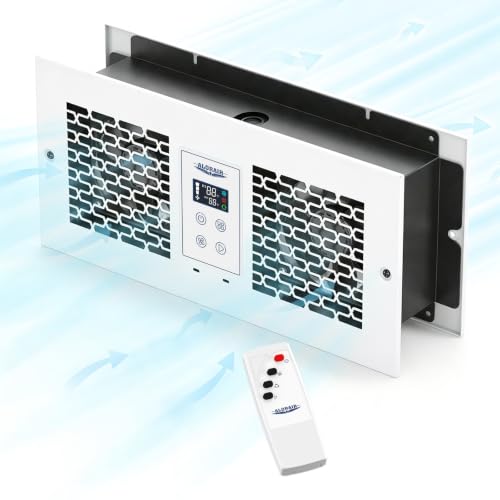
- Built-in Cooling & Heating for True Temperature Control: Unlike ordinary air transfer fans that only move existing air, this one-way airflow unit comes with three selectable
- Precision Thermostat Control: The integrated precision temperature sensor continuously monitors the environment to trigger the built-in cooling or heating system, not just the
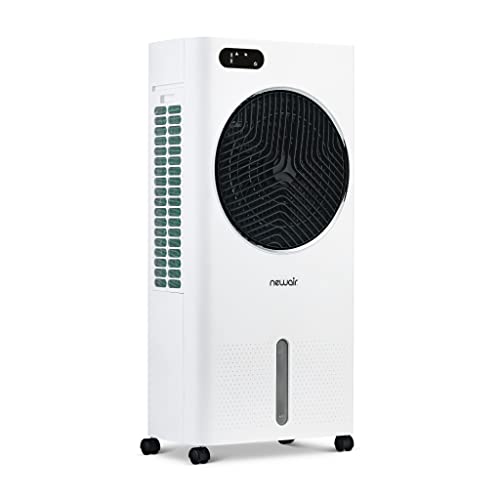
- ECO-FRIENDLY EVAPORATIVE COOLING WITH ICE CHAMBER – Built for efficient cooling, this portable air cooler uses natural evaporative cooling with a honeycomb cooling pad that cools
- PORTABLE ROOM COOLING WITH REMOVABLE WATER TANK – Designed for easy mobility, this evaporative cooler features easy-roll casters and lightweight construction for convenient
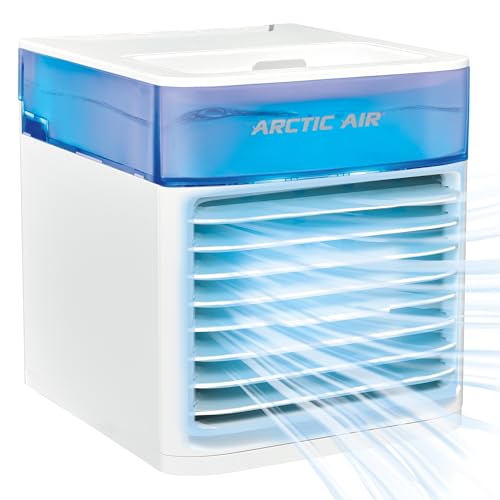
- Personal Air Cooler for Indoor & Outdoor Spaces: Switch to an eco-friendly solution with Ontel Arctic Air Pure Chill Deluxe. Featuring Hydro-Chill Technology and cooling control
- Space-Saving Portable Design: The compact, sleek design allows you to place the box cooler on your office desk, nightstand, coffee table, or kitchen counter. It is lightweight, so
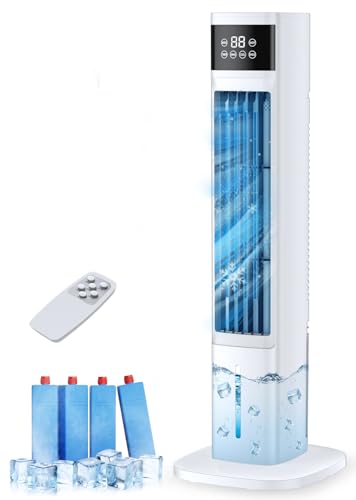
- 3-in-1 Multifunctional Evaporative Air Cooler: Not only an air cooler, but also can easily switch between humidifier/natural wind mode; cooling mode effectively resists hot
- Rapid Refrigeration And Cooling: Air conditioner portable for room adopts advanced water cooling technology, upgraded high-performance motor, and innovative air duct design, and
The honest physics, in one paragraph
Without a compressor and a way to dump heat outside, a device can't remove heat from a sealed room. Evaporative coolers get around this by using water: dry air passes over a wet pad, water evaporates, and the air comes out cooler and wetter. That trade is great in Phoenix and useless in Houston. Fans don't cool a room at all — they cool you, by pulling heat off your skin. Once you internalize that, the buying decision gets much simpler: are you trying to cool a room, or cool a person?
Who this approach is for
You're a good fit for room-by-room cooling without central air if:
Finding the right how to cool room without central air comes down to matching the features to how you will actually use it.
- You live somewhere dry. Evaporative cooling is a real temperature drop in arid air. The Newair listing explicitly frames itself as ideal for "dry, hot environments west of the Mississippi" — that's not marketing fluff, that's the technology's actual constraint.
- You rent, or can't cut a hole in a wall. Every portable unit here needs a plug and a bucket of water, not a window kit or a hose.
- You only need one or two rooms cool. Spot-cooling a bedroom at night is far cheaper than conditioning a whole house.
- You already have AC somewhere in the house but it doesn't reach. This is the specific problem the ALORAIR transfer fan solves — it's a one-way unit that pushes air from a room that's already comfortable into an adjacent room that isn't.
- Your electric bill is the actual pain point. The Newair runs at 110 watts; the Arctic Air Pure Chill Deluxe at 8–10 watts. A window AC pulls roughly an order of magnitude more than the Newair.
Who should skip all of this
Be honest with yourself and walk away if:
- You live in the humid South or a coastal climate. Adding water vapor to already-saturated air is the opposite of what you want. Evaporative coolers will make the room feel clammier. Get a window unit or a hosed portable AC instead.
- You need a specific, reliable temperature. None of these hold a room at 72°F. The ALORAIR has a thermostat, but it's conditioning transferred air through a wall opening, not managing a whole room's heat load.
- The room is large or sun-blasted. The Newair rates itself for spaces up to 250 square feet. A 400-square-foot west-facing living room in August is out of scope for everything on this page.
- You won't maintain it. Every evaporative cooler has a wet pad and a standing water tank. If you're not going to empty and clean it, don't buy it — you'll end up with a musty-smelling fan.
- You're mold-sensitive or already run a dehumidifier. You'd be fighting your own equipment.
The trade-offs nobody puts on the box
Humidity is the whole game, and it cuts both ways. The KOTEK listing is unusually straightforward about this, stating outright that its cooling capacity "differs from that of a conventional air conditioner and may not achieve the same level of temperature reduction," and that it "works better in a dry environment." Believe that sentence. It applies to every evaporative unit here, not just the KOTEK.
Ice packs are a short-term boost, not a feature. The MELOPHY, KOTEK and Newair all ship with ice packs or ice boxes. They genuinely help — for as long as the ice lasts. Plan on a freezer rotation if you want that effect all evening.
"Portable air conditioner" in a product title often means evaporative cooler. The MELOPHY is literally named "Portable Air Conditioners for Room" and then describes itself as a swamp cooler needing "no windows... or no hoses." That's not a lie, but it's the kind of naming that leads to disappointed buyers. Read the mechanism, not the headline.
Personal coolers cool a person, period. The Jiawu unit holds 500 mL and sits on a desk. The Arctic Air Pure Chill Deluxe is designed for a nightstand or coffee table. Neither is going to change a room's temperature, and neither claims to. If your expectation is "my bedroom gets cooler," you'll be unhappy; if it's "the air hitting my face while I work is cooler and damper," you'll be fine.
Refill cadence is a lifestyle question. The MELOPHY claims 12+ hours from its 1-gallon tank; the Arctic Air claims up to 10 hours depending on speed, room temperature and humidity. Those caveats matter — high speed in hot dry air burns water fast.
What to check on the listing before you buy
Listings change constantly, so verify these yourself rather than trusting any article, including this one:
- Current price. Every figure above is a snapshot. Cooling gear is heavily seasonal and prices swing hard between May and September.
- The variant you're actually adding to cart. Color and size options often sit under one listing at different prices with different specs.
- Wall thickness, if you're going the ALORAIR route. It's specified for wall openings from 3.7" to 7.6" thick, with dimensions of 16.5" L x 7.7" H x 4.1" W. Measure your opening before ordering, not after.
- Warranty terms. ALORAIR states a 1-year manufacturer's warranty; the others don't state one in their listed features. Check the listing's warranty section directly.
- Whether ice packs are included. Several units advertise them as "free" — confirm they're in the box for your variant.
- Recent reviews, read yourself. Go look at what buyers say about water leaks, pad odor and noise after a season of use. That's the information no spec sheet gives you.
Alternatives worth considering
Newair Evaporative Air Cooler — consider instead if…
…you want the highest stated airflow here and a room-scale unit rather than a desk gadget. The Newair Evaporative Air Cooler | AC Portable Air Conditioner Alternative with 1,600 CFM Airflow | Room Cooling Fan for Bedroom, Garage & Indoor Use | White is rated at 470 CFM for spaces up to 250 square feet, weighs 17 pounds with easy-roll casters, holds 1.76 gallons in a removable tank, and draws 110 watts. It's ETL certified, includes a built-in dust filter and humidistat, and offers three fan speeds plus a 7.5-hour programmable timer via remote. It's also the priciest option at $199.00.
MELOPHY 3-in-1 Evaporative Air Cooler — consider instead if…
…you want tower-fan form factor and the longest timer. The Portable Air Conditioners for Room, 3-in-1 Evaporative Air Cooler, Fast Cooling Portable AC Unit/24H Timer, Remote Oscillating Tower Fan, 4 Modes 3 Speeds, Quiet Swamp Cooler for Bedroom Office runs a 1-gallon pull-out tank for 12+ hours, has a 19-inch airflow outlet with 60° tilt swing, a 24-hour timer, sleep mode, and a screen that shuts off after two minutes of no input — a genuinely thoughtful touch for a bedroom. It switches between cooling, humidifier and natural-wind modes.
KOTEK Evaporative Air Cooler — consider instead if…
…tank size and mobility matter most. The KOTEK Evaporative Air Cooler, 3-in-1 Portable Air Cooler for Bedroom with Fan & Humidifier, 3 Wind Speeds, Bladeless Ice Water Fan Swamp Cooler w/ 4 Casters, 2 Ice Boxes for Home & Office carries a 4L tank, includes two ice boxes, and rolls on 360° casters with two lockable rear wheels and a built-in handle. Controls are three touch buttons on top — a real advantage if anyone in the house finds fussy interfaces annoying.
Arctic Air Pure Chill Deluxe — consider instead if…
…you only need cool air at one seat. The Arctic Air Pure Chill Deluxe Evaporative Air Cooler - Powerful, Quiet, Lightweight And Portable Space Cooler With Hydro-Chill Technology For Bedroom, Office, Living Room & More draws just 8–10 watts, runs up to 10 hours on a top-fill tank, and offers four speeds, multi-directional vents and a seven-color LED nightlight. At $35.20 it's the low-risk way to find out whether evaporative cooling does anything useful in your climate.
Jiawu Mini Evaporative Air Cooler — consider instead if…
…you want mist rather than airflow alone. The Portable Air Conditioner, Mini Evaporative Air Cooler, Personal Air Cooling Fan with 7 Colors Light, Powerful 6 Speeds & Cool Air Sprays Humidify AC for Office Table Home School uses ultrasonic nano-mist to throw a fine spray that the listing says evaporates on contact without wetting clothes. It has six speeds, 60° manual vertical tilt, a 500 mL container rated for up to 8 hours, and seven light colors. At $31.40 it's the cheapest entry point on this page.
FAQ
Will an evaporative cooler work in a humid climate? Not well. These units cool by evaporating water into the air, so the drier the air, the bigger the temperature drop. The KOTEK listing says plainly that it "works better in a dry environment." In humid conditions you're mostly buying a fan that also raises the moisture level.
Do any of these need a window or a hose? No. The MELOPHY listing specifically notes that no window or hose is needed — you install the base and plug it in. The ALORAIR is the exception in a different direction: it's not a window unit either, but it mounts into a wall opening between two rooms, so it does require installation.
How is the ALORAIR different from an ordinary fan? Its listing distinguishes it from "ordinary air transfer fans that only move existing air." It has three selectable modes — cooling, heating, ventilation — and a temperature sensor that triggers the built-in cooling or heating system rather than just the fan, with a settable range of 23°F to 104°F and three speeds.
Can I run these all night without refilling? Usually, depending on speed. The MELOPHY cites 12+ hours from 1 gallon, the Arctic Air up to 10 hours with the caveat that it depends on speed setting, room temperature and humidity, and the Jiawu up to 8 hours of humidification from 500 mL. Higher speeds in hotter, drier air consume water faster than the headline number suggests.
Related guides
- Best home cooling, heating and fans - ceiling fans, tower fans, space heaters, misting fans, portable air conditioners, window air conditioners for Small Business Owners
- How to Install a Window Air Conditioner
- The Best Window Air Conditioners for Every Room Size
Key Takeaways
- Choosing the right how to cool room without central air means matching the key features to your specific needs and budget
- Read real customer reviews and check the return policy before you commit
- Compare value across models — the priciest option is not always the best fit