As an Amazon Associate this site earns from qualifying purchases.
Comparison table
| Model | Price | Wattage | Stated coverage | Noise | Oscillation | Remote | Timer |
|---|---|---|---|---|---|---|---|
| Dr Infrared Heater DR-968 | Check price on Amazon | 1500W (~5200 BTU) | "Large room" (not stated in sq ft) | 39 dB | Not stated | Yes (IR) | 12-hour auto shut-off |
| DREO 30" 120° Oscillation | Check price on Amazon | Not stated | Up to 300 ft² | 25 dB | 30°/60°/90°/120° | Yes | Not stated |
| PELONIS Oil Filled Radiator | Check price on Amazon | 1500W (600/900/1500) | "Large space" (not stated in sq ft) | Fan-free | No | No | Not stated |
| DREO 25 Inch | Check price on Amazon | Not stated | 100–270 sq ft | As low as 25 dB | 70° wide angle | Not stated | Not stated |
| DREO Large Room ECO | Check price on Amazon | Not stated | Up to 250 sq ft | 34 dB | 70° wide | Not stated | 12-hour |
| DREO Portable 1500W PTC | Check price on Amazon | 1500W | Not stated | 34 dB | Not stated | Yes | 12-hour |
Quick answer: For most big living rooms and open basements, the Dr Infrared Heater DR-968 Portable Space Heater, 1500-Watt, Cherry is the one to beat — it's rated around 5200 BTU from a dual infrared-plus-PTC system and rolls on caster wheels. If you want quiet, oscillating warmth for a 250–300 sq ft room, look at the DREO Space Heater Large Room, 120° Oscillation, 30" Heaters with Remote; if you want steady, fan-free heat that lingers, the PELONIS Radiator Heater for Large Space, Electric Oil Filled Radiator, Dual Knobs, 1500W, Quiet Space Heater, 3 Modes, Tip-over Protection is the oil-filled pick.
Here's the thing nobody tells you when you search for a "1000 sq ft space heater": that product basically doesn't exist in a 120V plug-in form. Every heater on this page — and nearly every plug-in heater sold in the US — tops out at 1500 watts, because a standard 15-amp household circuit can't safely give you more. 1500W is roughly 5,100 BTU, and that's the ceiling. So the real question isn't "which heater does 1000 square feet," it's "which 1500W heater moves its heat around a big space most effectively, and which one won't drive you crazy while it does it."
That's what separates these six. Below, each one, and who it's actually for.
The best best space heaters large rooms for your situation depends on how you plan to use it and where.
Dr Infrared Heater DR-968 — Best Overall
The Dr Infrared Heater DR-968 Portable Space Heater, 1500-Watt, Cherry is the closest thing here to a "just heat the whole room" appliance. It uses a dual heating system — an infrared quartz tube plus PTC ceramic — which the manufacturer rates at around 5200 BTU and describes as producing 60% more heat than others. Infrared heat has a useful quirk: it warms objects and people directly rather than just the air, so a big drafty room feels warmer sooner even before the air catches up.
Practical details matter at this size. It weighs 19 lbs and rides on caster wheels, so moving it from the living room to the basement isn't a chore. The blower is a high-pressure, low-noise design rated at 39 dB. You get an IR remote, an electronic thermostat with a 50–85°F range, a 12-hour automatic shut-off timer, a lifetime filter, and a 72-inch (6-foot) power cord — which is longer than most and genuinely helpful when the only outlet is behind the couch. It draws 12.5 amps at 1500 watts, so give it its own circuit.
Tip-over and overheat protection are both included. At $112.99 it's the priciest per-watt option here, but for a genuinely large, cold room it's the one I'd start with.
DREO Space Heater Large Room, 120° Oscillation, 30" — Best for Wide Coverage
If your problem is less "not enough heat" and more "the heat only reaches one chair," the DREO Space Heater Large Room, 120° Oscillation, 30" Heaters with Remote is built for exactly that. It's a 30-inch tower with a 308mm large PTC element and customizable oscillation at 30°, 60°, 90°, or 120° — the widest sweep in this lineup. DREO rates it for large rooms up to 300 ft², the highest coverage figure among the models here.
The noise number is the standout: 25 dB, which is about as quiet as a heater with a fan gets. If you're heating a bedroom or a home office where you're on calls all day, that matters more than another few hundred BTU. You get 9 comfort levels total — 5 heat levels plus ECO, and 3 fan-only levels for circulating air when the room is warm enough.
Safety is thorough: 8 protections including V0 flame-retardant material, cool-touch housing, the FortPlug, thermal insulated wiring, child lock, 45° tip-over protection, and overheat protection, all ETL certified. DREO claims up to 50% energy savings via controllable silicon technology for precise temperature control. One caveat straight from the manufacturer: they ask that you ensure a stable voltage environment at home for optimal performance. At $129.99 it's the most expensive here, and you're paying for coverage and silence rather than raw output.
PELONIS Radiator Heater for Large Space — Best for Quiet, All-Night Heat
Oil-filled radiators work differently, and for some rooms that's the whole point. The PELONIS Radiator Heater for Large Space, Electric Oil Filled Radiator, Dual Knobs, 1500W, Quiet Space Heater, 3 Modes, Tip-over Protection has no fan at all — heat rises off the fins and circulates naturally. PELONIS notes this gentle hot air circulation avoids the dryness you get from forced-air heat, which is a real complaint in winter bedrooms.
Because there's no fan construction, it's genuinely silent, not "quiet for a heater." Three heating modes — 600W, 900W, and 1500W — let you dial power down once the room is up to temperature, which is where the energy savings live. It has dual knob controls (no digital display, no remote), a power indicator light, overheat protection, and a tip-over safety switch. Four heavy-duty universal casters and a front carrying handle make it easy to roll between rooms.
The trade-off is honest: oil radiators are slow. They take a while to come up to temperature and a while to cool down. For a room you want warm all evening or overnight, that thermal mass is a feature. For a room you want warm in ninety seconds, it isn't. At $79.99, it's the value play for steady background heat.
DREO 25 Inch Electric Space Heater — Best for Fast, Directed Heat
The DREO 25 Inch Electric Space Heater for Indoor Use, Large Room, Thermostat leans on airflow speed: 11.5 ft/s, the fastest air velocity quoted in this group, thanks to a hyperamics thermal design and an extended impeller that DREO says doubles the heat range. Fast-moving air is how you get warmth across a room instead of just in front of the unit.
Coverage is stated at 100–270 sq ft with 70° wide-angle oscillation. Noise drops as low as 25 dB. Temperature control runs 41–95°F in 1°F increments using a dedicated thermal sensor that adjusts heating automatically in ECO mode. There are four heating modes (H1/H2/H3/ECO) plus a fan-only option for circulating air in warmer weather.
Safety spec: V0 flame retardant material, reinforced plug, 45° tip-over and overheat protection, ETL certified, plus a child lock. At $89.99 this is the middle-ground pick — more reach than the compact DREO, less coverage and no 120° sweep compared to the 30-inch model.
DREO Space Heater for Large Room, Quiet Electric Heaters ECO — Best for Energy Savings
The DREO Space Heater for Large Room, Quiet Electric Heaters for Indoor Use ECO is the one to look at if your worry is the January electric bill. DREO claims up to 40% energy savings in ECO mode, with precise temperature control from 41–95°F in 1°F increments, 3 heat levels, and a fan mode.
The hardware behind it: dual DC motors that double airflow to 10 ft/s, a 25% larger heating plate, and a stated 2-second heat-up. Coverage is rated up to 250 sq ft with 70° wide oscillation. Noise sits at 34 dB — quiet, though not as quiet as the 25 dB models above. A 12-hour timer handles all-day heating without you babysitting it.
Safety includes child lock, safety plug, overheat protection, tip-over protection, and cool-touch housing, ETL-listed. At $79.97 it ties the PELONIS as the cheapest large-room option here, and it's the better choice of the two if you want fast heat and oscillation rather than silent radiant warmth.
DREO Space Heater, Portable Electric Heaters with Thermostat and Remote — Best Budget Pick
At $39.99, the DREO Space Heater, Portable Electric Heaters for Indoor Use with Thermostat and Remote, 2024 Upgraded, Digital Display, 12H Timer, 5 Mode, 1500W PTC Ceramic Fast Safety Heat for Office Bedroom Home is a third the price of the top pick and still runs the full 1500W. It pairs a Hyperamics 1500W PTC system with a heat funnel design that DREO says reaches up to 200% farther than traditional heaters.
You get an enhanced NTC chipset for temperature control across 41–95°F in 1°F increments, a brushless DC motor with a winglet fan design that holds noise to 34 dB, and modes covering Power heat, ECO, and Fan Only. Extras are surprisingly complete for the price: remote control, 12-hour timer, mute, child lock, memory function, digital display, and a carry handle. Safety covers a tilt-detection sensor, V0 flame retardant materials, overheat protection, and a safety plug, ETL certified.
What it doesn't have is a stated square-footage rating or oscillation. For a large room, that means it heats a zone rather than sweeping the space. If you mostly need to warm the corner where you actually sit, it's plenty — and it's an easy second unit for another room.
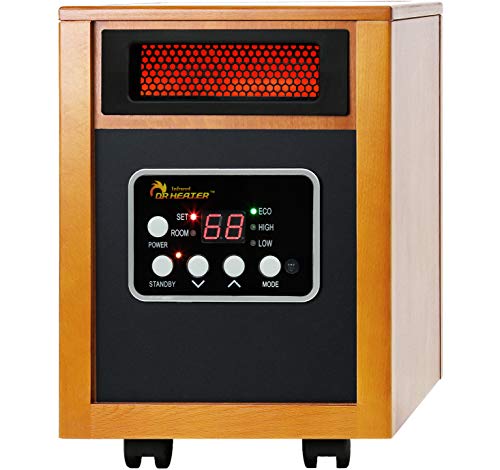
- Can heat up a large room with Auto Energy Saving Model With High and Low Feature. Tip-over protection and Overheat protection.Heat Up for a large room - Dual Heating System
- Dual Heating Systems featuring infrared quartz tube + PTC with 12-Hour automatic shut-off timer. Amperage: 12.5 Amps
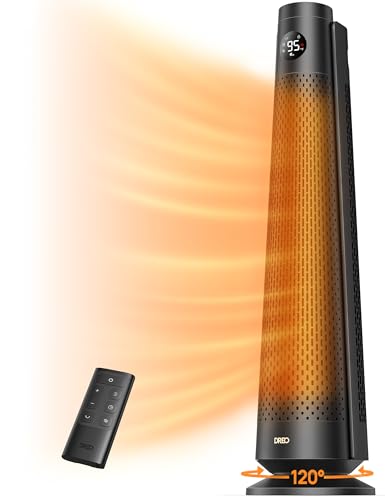
- Powerful and Widespread Heating: Experience instant and efficient warmth with DREO's 30" ceramic heater featuring a 308mm large PTC element, upgraded Hyperamics thermal design
- All-around Safety: Stay warm this winter with peace of mind. Our heaters for indoor use offers 8 comprehensive protections, including V0 flame-retardant material, cool-touch
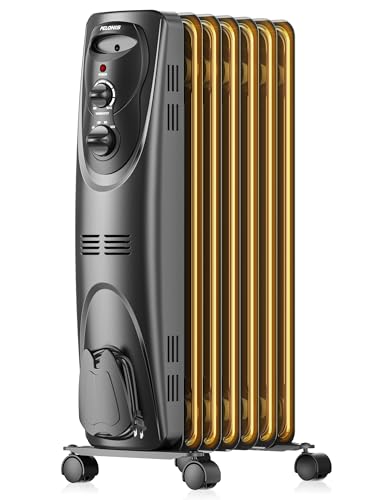
- 𝑭𝒂𝒔𝒕 𝑯𝒆𝒂𝒕𝒊𝒏𝒈, 𝑳𝒂𝒔𝒕𝒊𝒏𝒈 𝑪𝒐𝒎𝒇𝒐𝒓𝒕: The 1500W power heats the whole house rapidly and the hot air circulation delivers long-lasting and gentle warmth which
- 𝑬𝒏𝒆𝒓𝒈𝒚 𝑬𝒇𝒇𝒊𝒄𝒊𝒆𝒏𝒕: Equipped with 3 heating modes 600W/900W/1500W, which can also be used in combination to help save energy bills in winter
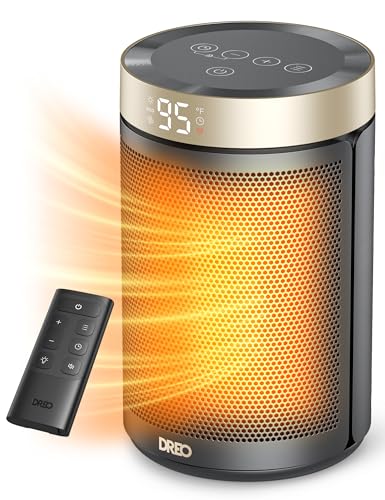
- Powerful heat that fits everywhere: DREO space heaters for indoor combines Hyperamics 1500W advanced PTC system with a new heat funnel design to deliver heat within seconds and
- Unbreakable safety:DREO goes beyond the unexpected to deliver peace of mind with every room heater. The innovative tilt-detection sensor improves accuracy and reliability for
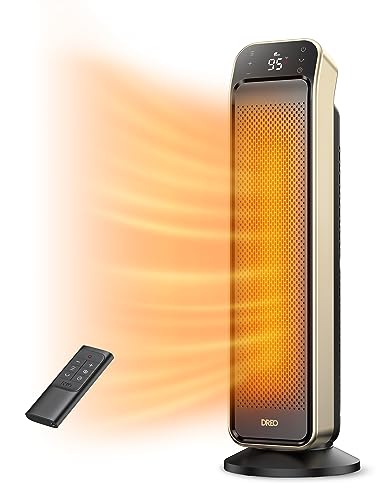
- The Ultimate Heating Experience: DREO's upgraded 25" space heaters for indoor use brings 11.5 ft/s fast heat thanks to its new hyperamics thermal design, while the extended
- Warm Your Nights in Absolute Quietness: DREO's new airflow design brings down noise as low as 25dB, making this space heater for bedroom an ideal option to blow a comfortable warm
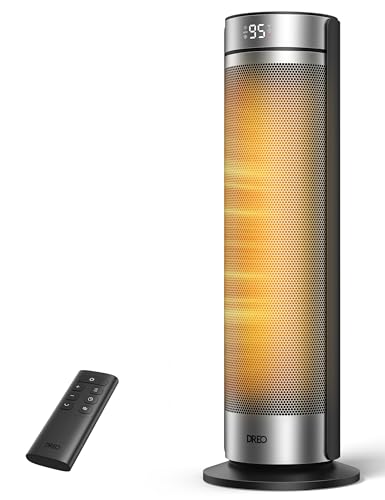
- Twice the heat power: With dual DC motors, this DREO space heater for indoor use doubles airflow at 10ft/s, heats up in 2s, plus a 25% larger heating plate that efficiently warms
- Worry-free warmth: With child-lock, safety plug, overheat, tip-over protection and cool-touch housing, this ETL-listed electric heater provides safe, efficient warmth indoors
How to choose a heater for a large room
Accept the 1500W ceiling. Every plug-in heater here maxes at the same wall-outlet limit. If you're searching for a heater for 1000 square feet, no single 120V unit will do it well — you're looking at two units, or a hardwired/240V solution outside this category.
Airflow beats raw wattage. Since output is capped, what separates these is how far and wide the heat travels. That's why the specs to compare are air velocity (11.5 ft/s on the DREO 25-inch, 10 ft/s on the ECO model), oscillation angle (120° on the 30-inch DREO, 70° on the others), and stated coverage.
Convection versus radiant versus oil-filled. Ceramic PTC heaters with fans (the four DREOs) heat fast and stop fast. Infrared (the Dr Infrared's quartz tube) warms objects and people directly, which feels warmer in a drafty room. Oil-filled (PELONIS) is slow both ways but silent and steady — best where you'll be for hours.
Noise is a real spec, not a footnote. The gap between 25 dB and 39 dB is the gap between "I forgot it was on" and "I can hear it during a movie." If the heater lives in a bedroom or office, weight this heavily.
Check the circuit before you check out. The Dr Infrared draws 12.5 amps. On a 15-amp circuit that leaves almost nothing. Don't share the breaker with a space heater and a microwave, and never use an extension cord with any of these.
Safety features to insist on. Every model here has tip-over and overheat protection. The DREOs add ETL certification, V0 flame-retardant material, and child lock — worth prioritizing if kids or pets share the room. And do read current owner reviews on the product pages before buying; they'll tell you how a unit holds up over a second and third winter in a way spec sheets can't.
FAQ
What size space heater do I need for a 1000 sq ft room? Larger than anything that plugs into a standard outlet. All six here are 1500W-class units, and stated coverage tops out at 300 ft² (the DREO 30-inch). For a genuinely open 1000 sq ft space, plan on supplementing central heat, running two units, or looking at a hardwired system.
Which of these is the safest? They all include tip-over and overheat protection. The DREO 30-inch lists the most: 8 protections including V0 flame-retardant material, cool-touch housing, FortPlug, thermal insulated wiring, child lock, 45° tip-over, and overheat, all ETL certified. The PELONIS has no exposed heating element at all, which some people prefer around kids.
Is an oil-filled radiator cheaper to run than a ceramic heater? At the same wattage, no — 1500W costs the same regardless of type. The savings come from modes. The PELONIS lets you run at 600W or 900W; the DREO ECO model claims up to 40% savings in ECO mode and the 30-inch claims up to 50%. Running lower wattage longer is usually cheaper than blasting 1500W in bursts.
Do I need oscillation? In a large room, yes. Without it a heater warms a cone in front of itself. The 120° sweep on the DREO 30-inch and the 70° on the 25-inch and ECO models is what turns a spot heater into a room heater.
Related guides
- Best home cooling, heating and fans - ceiling fans, tower fans, space heaters, misting fans, portable air conditioners, window air conditioners with High Value Assets
- FAQ: Best home cooling, heating and fans - ceiling fans, tower fans, space heaters, misting fans, portable air conditioners, window air conditioners
- Privacy Policy
Key Takeaways
- Choosing the right best space heaters large rooms means matching the key features to your specific needs and budget
- Read real customer reviews and check the return policy before you commit
- Compare value across models — the priciest option is not always the best fit