As an Amazon Associate this site earns from qualifying purchases.
Specifications
| Spec | Hunter Original, Outdoor or Indoor, Ceiling Fan, 52 inch, Matte Black |
|---|---|
| Blade span | 52 inches |
| Blade count | 5 (per the Chestnut Brown listing of the same Original 23847 fan) |
| Motor | 3-speed WhisperWind, reversible |
| Airflow tech | SureSpeed |
| Location rating | Damp-rated (covered outdoor: patios, porches, garages) — also for large indoor rooms |
| Control | Pull chain |
| Light kit | None |
| Mount | Standard mount |
| Finishes listed | Matte Black; Chestnut Brown |
| Price | $749.99 |
| CFM / watts / weight / warranty | Not stated |
Quick answer: The Hunter Original is a 52-inch, damp-rated, pull-chain ceiling fan with a 3-speed reversible WhisperWind motor and SureSpeed technology, and at $749.99 it costs roughly five times what Hunter's own Builder-series fans do. You are paying for the traditional cast housing and the covered-outdoor rating, not for extra features — there is no light kit and no remote. If you want the look and the damp rating, it's the fan; if you want airflow per dollar in a bedroom, Hunter sells much cheaper fans with the same motor branding.
Hunter Original, Outdoor or Indoor, Ceiling Fan, 52 inch, Matte Black is the black version; the Hunter 52 inch Outdoor or Indoor Ceiling Fan No Light - Brown Ceiling Fan without Light, For Patio, Porch, Garage, or Living Room, Standard Mount, 5 Blades, Pull Chain - Original 23847, Chestnut Brown is the same fan in Chestnut Brown at the same $749.99.
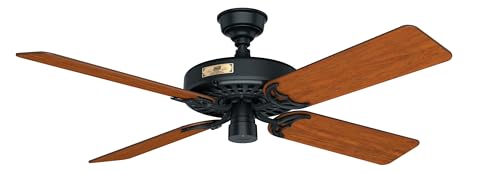
- AIRFLOW YOU FEEL: The Hunter Original ceiling fan features SureSpeed technology to deliver faster, more focused airflow while maintaining quiet, wobble-free performance in indoor
- VERSATILE OUTDOOR OR INDOOR USE: This 52 inch ceiling fan is damp-rated for covered outdoor areas like patios or garages and also works well in large indoor rooms
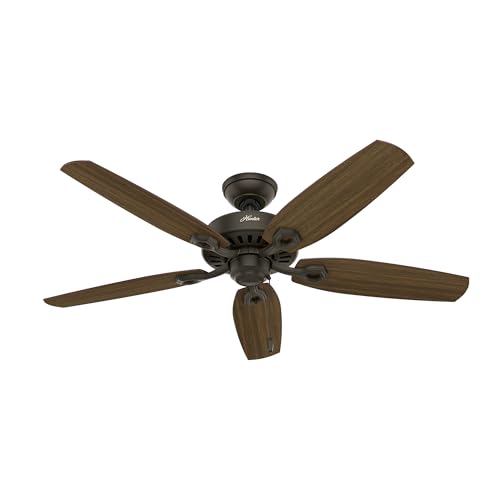
- STANDARD MOUNTING SYSTEM: The Builder Elite includes a 3 inch downrod for mounting on standard or angled ceilings, providing flexible installation options to fit a variety of room
- DESIGNED FOR INDOOR COMFORT: This 52 inch ceiling fan helps maintain airflow and a comfortable environment in large bedrooms, living rooms, kitchens, and home offices
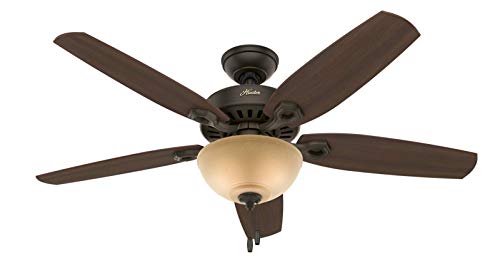
- CEILING FAN WITH LIGHT: The Builder Deluxe includes energy efficient LED bulbs to deliver bright, reliable lighting for everyday comfort and visibility throughout the home
- DESIGNED FOR INDOOR COMFORT: This 52 inch ceiling fan helps maintain airflow and a comfortable environment in large bedrooms, living rooms, kitchens, and home offices
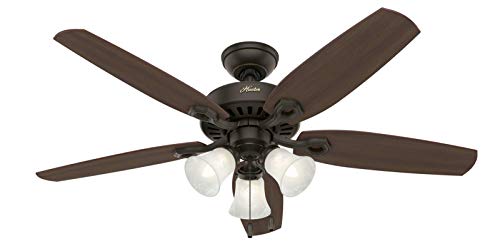
- CEILING FAN WITH LIGHTS: The Builder Plus includes energy efficient LED bulbs to deliver bright, reliable lighting for everyday comfort and visibility throughout the home
- DESIGNED FOR INDOOR COMFORT: This 52 inch ceiling fan helps maintain airflow and a comfortable environment in large bedrooms, living rooms, kitchens, and home offices
Are Hunter ceiling fans good?
That's the question most people are really asking, and the honest answer is "it depends which Hunter." Hunter's catalog spans a $110 flush-ish indoor fan and this $750 traditional piece. The shared thread across the line is the 3-speed WhisperWind motor with reversible operation — Hunter puts that same motor description on the $149.99 Builder fans and on the $749.99 Original. So the motor branding alone doesn't tell you where the money goes.
Finding the right hunter original ceiling fan review comes down to matching the features to how you will actually use it.
What separates the Original is the description Hunter uses for it: SureSpeed for faster, more focused airflow, wobble-free performance, damp rating for covered outdoor use, and a design that has been, in Hunter's words, "proudly displayed in homes for decades." That heritage framing is why people search for "1930s ceiling fan" and land here. Hunter is one of the older names in American ceiling fans, and the Original is the model that trades on that.
Whether that's worth $600 over a Builder fan is a taste-and-placement question, not a performance question you can settle from spec sheets. Before you commit at this price, go read the current Amazon reviews yourself and pay attention to what recent buyers say about wobble, hum, and hardware quality — that's the kind of thing that changes with production runs, and you should check it fresh rather than trust any article, including this one.
Who the Hunter Original is for
- You have a covered patio, porch, or garage. This is the headline reason to pay up. The Original is damp-rated for covered outdoor areas. Most cheap indoor fans are not, and putting an indoor-rated fan under a porch roof is how you get a rusted-out motor in two seasons.
- You want a traditional look that reads "old house," not "builder-grade." Matte Black and Chestnut Brown are both period-appropriate finishes for a Craftsman, farmhouse, or pre-war interior.
- You don't want a remote. Pull chain only, three speeds. Nothing to pair, nothing to lose in the couch, no battery in the wall control.
- You want no light. The Original has no light kit at all, which is exactly right over a patio table you already light with string lights, or in a room where the ceiling fixture is elsewhere.
- You're cooling a large room. The 52-inch span is aimed at big bedrooms, living rooms, and open covered areas.
Who should skip it
- You're on a budget. $749.99 for a fan with no light and no remote is a lot. Hunter's own Builder Elite is $149.99 with the same 3-speed WhisperWind motor and the same 52-inch span. If nothing about the outdoor rating or the traditional casting matters to you, you're paying five times the price for looks.
- You need light from the fan. There's no light kit and no stated light-kit compatibility in the product data, so plan on a separate fixture.
- You want a remote or app control. Pull chain is the only control listed. If the fan goes above a staircase or in a vaulted room where you can't reach the chain, this is the wrong fan.
- It's going in a fully exposed location. Damp-rated is not wet-rated. Covered patio, yes. Open pergola in the rain, no.
- You want published CFM numbers to compare against. Hunter's listing describes airflow qualitatively; it doesn't give a CFM figure here. If you're spec-shopping on airflow-per-watt, you'll need to pull that data from the manufacturer directly.
Honest trade-offs
The single biggest trade-off is price against feature count. Feature-for-feature, this fan does less than a $150 fan: no light, no remote, same speed count, same motor family. What you get instead is the damp rating and the design. That's a legitimate purchase — a fan that suits the room and survives a porch is worth real money — but it's a purchase you should make with clear eyes rather than assuming a higher price means stronger airflow.
Second: pull chain in 2026 feels dated to some buyers and reassuring to others. Chains are simple and don't fail in the ways electronics do. They're also annoying if the fan is out of reach.
Third: "Original" is a name, not a guarantee of vintage construction. Hunter's copy leans on decades of heritage, and the styling reflects that, but the listing doesn't state motor type, housing material, or weight. Don't buy expecting a rebuilt 1930s cast-iron fan; buy expecting a modern fan styled like one.
Fourth: 52 inches is the whole line. Every fan on this page is 52 inches. If your room is small, or you have a low ceiling and standard-mount clearance is tight, size and mounting height matter more than which model you choose.
What to check on the listing before you buy
Listings change, and this one is expensive enough that a few minutes of checking pays for itself:
- Current price. $749.99 is what's listed at the time of writing. Ceiling fan prices move, and the Matte Black and Chestnut Brown variants can drift apart.
- The exact variant. Confirm the finish, the 52-inch span, and that you're on the no-light Original — not a similarly named Hunter fan.
- Warranty terms. Warranty length isn't stated in the product data, so read what the listing and manufacturer say, and confirm whether outdoor installation affects coverage.
- Mounting hardware. The Chestnut Brown listing specifies standard mount. If you have an angled or vaulted ceiling, check whether you need a longer downrod or an angle-mount kit, and whether it's included.
- What's in the box. No light kit is listed. If you assumed one, that's an assumption to kill before checkout.
- Recent buyer reviews. Sort by most recent and read for wobble, noise, and hardware complaints yourself.
Alternatives worth a look
Hunter Builder Elite, Indoor, Ceiling Fan, No Light, 52 inch, New Bronze — consider instead if…
…you want the same 52-inch span, the same 3-speed reversible WhisperWind motor, and the same no-light pull-chain simplicity, but indoors and for $149.99. It ships with a 3-inch downrod for standard or angled ceilings, which is a genuinely useful inclusion if your ceiling isn't flat. It's not damp-rated, so keep it inside. Hunter Builder Elite, Indoor, Ceiling Fan, No Light, 52 inch, New Bronze
Hunter Swanson, Indoor, Ceiling Fan, with LED Lights, 52 inch, Fresh White — consider instead if…
…you need the fan to also be the room's light and you want the cheapest way in. At $110.49 it's the lowest-priced fan here, includes energy-efficient LED bulbs, and uses pull chains for both fan speed and light. The fresh white finish suits casual and modern rooms rather than traditional ones. Hunter Swanson, Indoor, Ceiling Fan, with LED Lights, 52 inch, Fresh White
Hunter Builder Deluxe, Indoor, Ceiling Fan, Pull Chain, 52 inch, New Bronze — consider instead if…
…you want the traditional bronze look of the Original but indoors, with light, at $149.99. It pairs the warm New Bronze finish and classic detailing with LED bulbs and separate pull chains for fan and light. This is the closest visual substitute for the Original in a room that also needs illumination. Hunter Builder Deluxe, Indoor, Ceiling Fan, Pull Chain, 52 inch, New Bronze
Hunter Builder Plus, Indoor, Ceiling Fan, Pull Chain, 52 inch, New Bronze — consider instead if…
…the Builder Deluxe is out of stock or the Plus is cheaper on the day you look. It's the same $149.99, same New Bronze traditional styling, same 52-inch span, same 3-speed WhisperWind motor, and also includes LED bulbs with pull-chain control for fan and light. Compare the two listings side by side and take whichever is better priced. Hunter Builder Plus, Indoor, Ceiling Fan, Pull Chain, 52 inch, New Bronze
FAQ
Are Hunter fans good quality? Hunter is a long-established ceiling fan brand, and across the models here it consistently uses a 3-speed reversible WhisperWind motor. But "Hunter" spans $110 to $750 in this lineup alone, so quality varies by model, not by badge. Check the reviews on the specific model you're considering rather than judging the brand as a whole.
Can the Hunter Original go outside? On a covered patio, porch, or garage, yes — it's damp-rated for those locations. It is not rated for fully exposed, wet installations.
Does the Hunter Original come with a light? No. The Original is a no-light fan in both the Matte Black and Chestnut Brown versions. If you want a Hunter fan with lighting, the Swanson, Builder Deluxe, and Builder Plus all include LED bulbs.
Why does the Original cost so much more than the Builder fans? The listed differences are the damp rating for covered outdoor use, SureSpeed airflow technology, and the traditional Hunter Outdoor Original design. The Builder fans share the 52-inch span and the 3-speed WhisperWind motor description at $149.99 but are indoor-only.
How is Hunter different from Fanimation? Fanimation isn't covered in the product data here, so treat any head-to-head as something to research on both manufacturers' current spec sheets — particularly blade span, CFM, control type, and location rating, since those are the specs that actually decide the outcome.
Related guides
- Best home cooling, heating and fans - ceiling fans, tower fans, space heaters, misting fans, portable air conditioners, window air conditioners with Past Challenges
- The Best Space Heaters for Large Rooms
- Top 10 Tips for Best home cooling, heating and fans - ceiling fans, tower fans, space heaters, misting fans, portable air conditioners, window air conditioners
Key Takeaways
- Choosing the right hunter original ceiling fan review means matching the key features to your specific needs and budget
- Read real customer reviews and check the return policy before you commit
- Compare value across models — the priciest option is not always the best fit